

Home / Products / Biolog

Know who is
on your campus
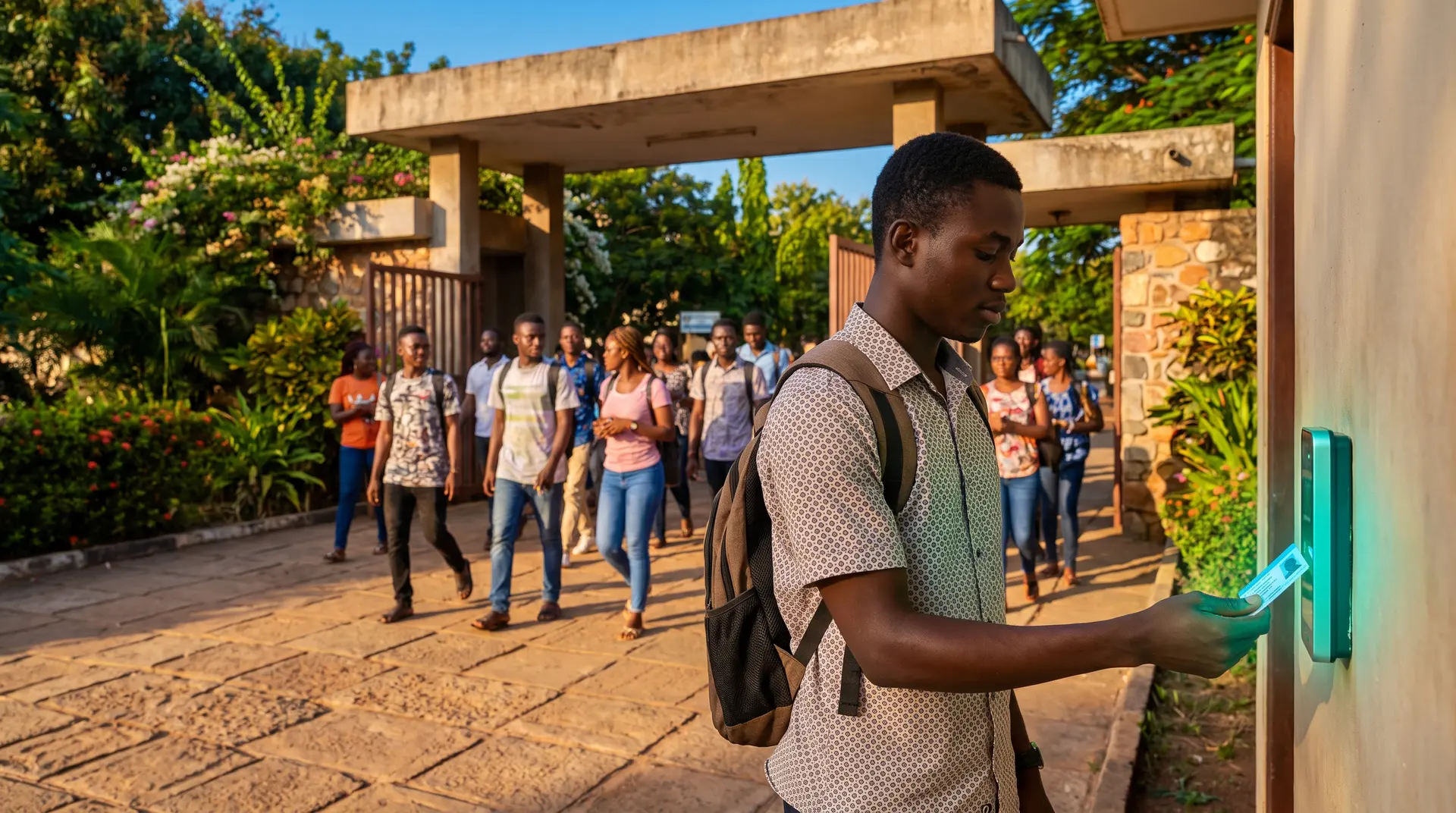
An encrypted identity card your institution alone can read, bound to the student record and checked at the gate, the hall and the exam desk.
// what it is
Biolog
An encrypted identity card your institution alone can read, bound to the student record and checked at the gate, the hall and the exam desk.
// the problem
What this replaces
Cards anyone can clone
A printed card with a barcode is a photocopy away from useless. Access control built on it is theatre.
Impersonation at examinations
Without verification at the desk, the person sitting the paper is whoever holds the card.
No record of who was where
When something happens on campus, the honest answer to “who was in the building” is that nobody knows.
Identity that lives apart from the record
A card issued by a print shop is not connected to the student record, so a suspended student's card still opens doors.
// what it does
Biometric identity,
RFID access, physical security
Capture once
Fingerprint, facial image and card issue in one sitting, bound to the student or staff record at the moment of capture.
Readable only by you
The credential is encrypted to the issuing institution. A card lifted from a campus is inert everywhere else.
Three factors
Card, fingerprint and face. Use one at a library turnstile, all three at an examination hall.
Gates, halls, hostels
RFID readers on entrances, laboratories, hostels and stores, with rules by role, level and time of day.
Presence, not signatures
Lecture and examination attendance recorded by tap rather than by a sheet passed along a row.
A queryable record
Every check is logged. Who was where, and when, is a query rather than an investigation.
// how it lands
Deployment, without
the ICT department losing control
Where verification matters
Not every door needs a reader. We identify the points where identity actually carries risk.
The population, once
Bulk enrolment sessions for existing students and staff, then continuous enrolment at admission.
Cards in hand
Printing and encoding on site, with the credential written against the live record.
One credential, more uses
Library, hostel, examination, canteen — added as the institution is ready.
- Factors on every check
- 3
- Encrypted to
- Your institution alone
// alongside this
Works with
EDUVANTAGE
One student record carrying admissions, registration, results, fees, identity and alumni — so the registry…
Read moreA1School
One tap at the gate marks attendance, opens the door and tells the parent. Pupils, staff and visitors pass…
Read moreAsset
Tagged asset registers with movement monitoring and location tracking across floors, rooms and exits — so the…
Read more// questions we are actually asked
Biometric identity management, RFID and access control
What is biometric identity management?
Capturing a person's fingerprint and facial image once, binding them to an institutional record, and using them afterwards to prove that the person presenting a credential is the person the credential was issued to. It replaces a printed card, which proves only that somebody is holding a card.
How does the RFID access control work?
Each student or staff member carries an encrypted RFID or NFC card. Readers on gates, halls, hostels, laboratories and stores check the card against the live record and apply rules by role, level and time of day. Because access reads the record rather than the card, a withdrawn or suspended student stops opening doors immediately, without anyone collecting the card.
Can a Biolog card be cloned or used at another institution?
The credential is encrypted to the issuing institution. A card lifted from your campus is inert everywhere else, and a copied card number does not verify because verification checks the encrypted credential rather than a printed barcode.
How does this stop examination impersonation?
At the examination hall the check can require all three factors — card, fingerprint and face — so the person sitting the paper must be the person registered for the course. At lower-risk points, such as a library turnstile, a single factor is enough.
Does it record who was on the premises?
Every check is logged with the person, the reader and the time. When a question arises about who was in a building or a hall, the answer is a query rather than an investigation. This is the physical security case for identity management: control at the point of entry, and evidence afterwards.